













CineDコミュニティエクスペリエンスに参加する
CineDの登録はまだですか?
登録 or
or
Every once in a while a lab test comes along that forces us to rewrite our own charts. This is one of those weeks. With the embargo on the DJI Osmo Pocket 4 Pro now fully lifted, we are publishing two lab tests – the DJI Osmo Pocket 4 Pro and its direct rival, the Insta360 Luna Ultra. Nino sat down with Gunther Machu to examine both sets of results in detail.
The comparison produced two records, but at opposite ends of the scale. One camera delivered the best dynamic range figure we have ever measured in more than 70 camera tests, while the other delivered the worst exposure latitude result we have ever recorded. Here is what happened.
This episode is brought to you by Hollyland and the Lark A1 wireless microphone. Check it out at 33:26 in this episode. Learn more by clicking this link!

Image Credit: CineD
(02:42 in the episode)
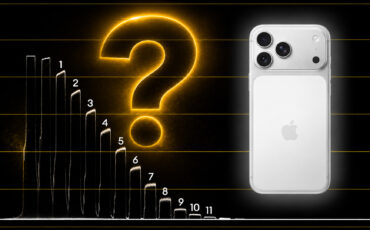
Until now, the CineD lab has focused on interchangeable-lens cameras – full frame, Super 35 and Micro Four Thirds. Fixed-lens devices such as gimbal cameras and drones were left out for two practical reasons. First, a 20mm equivalent wide lens has to sit extremely close to the Xyla21 chart, which invites reflections from the bright patches into the dark ones and skews the result. Second, many of these devices apply scene-dependent computational processing that never truly switches off. The iPhone 17 Pro is the cautionary tale here: even locked to manual mode, Apple Log 2, fixed shutter and fixed exposure, the waveform still shifted by around three stops depending on where the tap-to-focus point was placed. That makes a repeatable lab test impossible, which is why those results were never published.
Both the Osmo Pocket 4 Pro and the Luna Ultra behave differently: in manual mode, manual really means manual. To beat the reflection problem, Florian broke the symmetry of the setup, added a small Tilta matte box and some do-it-yourself flags until the chart read cleanly. A faint reflection is still visible on the shadow side of the waveform, and both lab test articles say so openly.
Read more: How we test dynamic range at CineD

Image Credit: CineD
(09:08 in the episode)
The wide camera of the Osmo Pocket 4 Pro uses a sensor built around LOFIC – lateral overflow integration capacitor. Unlike dual gain, which combines a high and a low ISO readout and typically doubles rolling shutter, LOFIC stores the overflowing charge from the brightest photosites in an on-sensor capacitor during the same exposure. The result is roughly two extra stops of highlight headroom with no rolling shutter penalty. That headroom can then be spent by moving the grey point, keeping shadow performance intact at the same time.
DJI has not confirmed the supplier, but the sensor appears to be an OmniVision part released in April. Sony has a LOFIC sensor of its own aimed at smartphones, rated at 100 dB – roughly 16.6 stops once converted – and its diameter happens to match the tele sensor in the Pocket 4 Pro. In other words, this technology is heading for smartphones, and probably before it reaches large-sensor cameras.
One catch: LOFIC is only in the 20mm wide camera, and to use it you have to shoot the new 10-bit D-Log2 profile, which the tele camera does not support. If you try to switch to the tele camera while shooting in D-Log2, the camera simply refuses to do so. The workaround is a user shortcut to a second stored profile – functional, but clumsy, and easily fixable in firmware.
(13:36 in the episode)
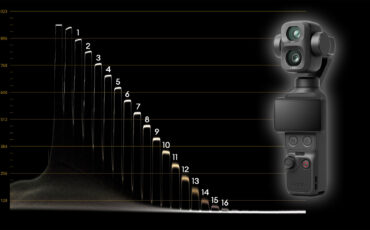
A Xyla21 shot in 10-bit 4K 25p D-Log2 at the native ISO1600 shows 16 stops of dynamic range above the noise floor, with a faint 17th stop buried inside it. For context, the ARRI ALEXA 35 – the previous leader – showed 15 above the noise floor. IMATEST confirms the reading: 16 stops at a signal-to-noise ratio of 2 and 17.2 stops at SNR = 1, exactly matching DJI’s 17-stop claim. Slope-based dynamic range reaches 18.3 stops, which is simply the maximum number of patches IMATEST could discern.
The obvious suspicion is noise reduction, because heavy NR can flatter these numbers. It does not apply here. The noise spectrum graph retains high amplitudes at high frequencies, which means fine black-and-white line pairs survive – a genuinely detailed 4K image with little to no internal noise reduction. It is the best result the CineD lab has recorded, and it comes from a one-inch sensor in a device that costs roughly a hundredth of an ALEXA 35.
Read more: DJI Osmo Pocket 4 Pro Lab Test: Rolling Shutter, Dynamic Range and Exposure Latitude
(22:32 in the episode)
Rolling shutter on the wide camera measures 11ms in D-Log2, including at 60 frames per second. That is solid rather than spectacular – we have seen 7ms and even 5ms elsewhere – but on a gimbal camera it is a non-issue. It also explains why the higher frame rate modes switch to a different subsampling readout: 4K 200fps would require around 5ms. The mid tele is quicker at 9.4ms.
The exposure latitude test is where cameras usually come back down to earth. Not this one. Even the strongest studio light could not clip the red channel on Nino’s forehead, and cross-referencing the Xyla21 RGB waveforms showed more than one stop of headroom still available beyond four stops over. Going down, four stops under and pushed back gives nine stops of exposure latitude with no noise reduction needed at all – a figure that only the Canon EOS R1 in RAW, the Sony a9 III and the RED lineup managed last year. Five stops under lands at ten stops plus, where a brownish cast and heavy internal vignetting appear once the shadows are lifted. Six stops under reaches eleven stops plus, but chroma blotches take over and noise reduction cannot rescue it.
Notably, the failure mode is not the sensor – there are no horizontal or vertical stripes, and the noise profile still looks clean. It is the 10-bit codec, where posterization and banding start to show. ARRI moved ARRIRAW to 13-bit on the ALEXA 35 for exactly this reason, and scored 12 stops of exposure latitude as a result. The Pocket 4 Pro’s solid 10 stops with room towards 11 puts it second in our database, behind one cinema camera and ahead of everything else.
(34:30 in the episode)
The tele uses a conventional 1/1.28-inch sensor with standard D-Log at native ISO400. It allows three stops of overexposure before the red channel clips – about two stops less highlight headroom than the wide – and delivers 8 stops of exposure latitude, with 11.6 / 12.9 stops at SNR = 2 / 1 in IMATEST. At six stops under the image breaks apart and not even DaVinci Resolve’s AI Ultra noise reduction brings it back. Eight stops from a sensor this small is a genuinely good result in 2026; there are consumer full-frame cameras that barely reach it. Crucially, DJI does not overdo the internal noise reduction, so the two cameras cut together far better than expected.
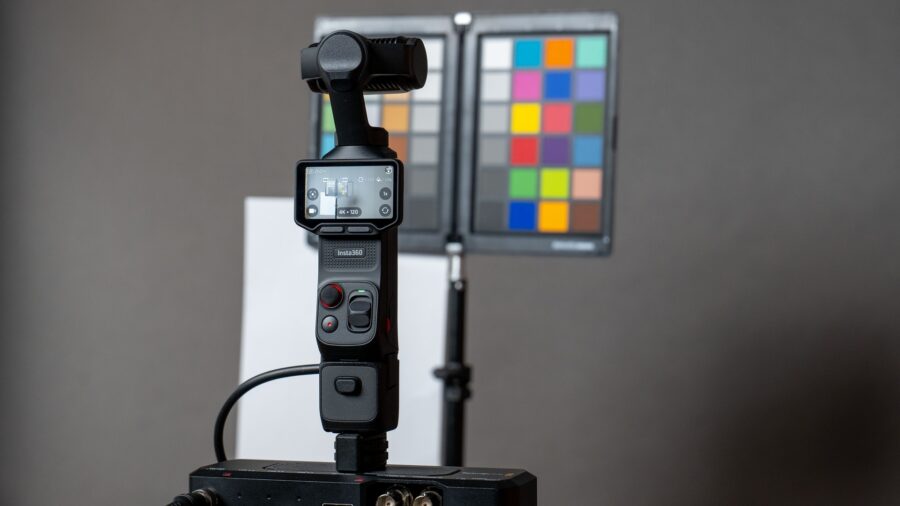
Image Credit: CineD
(38:07 in the episode)
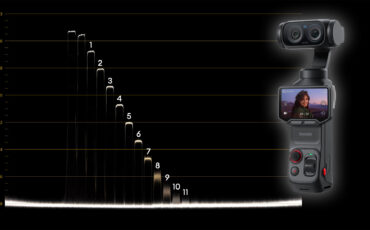
The Luna Ultra pairs a Leica Summicron-branded 20mm equivalent F1.8 one-inch main camera with a 60mm equivalent F2.0 1/1.3-inch tele. Rolling shutter on the wide camera in 8K is 10.9ms, the same for 4K25 and 4K60, dropping to 7.4ms in 4K120. The tele in 4K25 is also 10.9ms – but in 8K it jumps to a poor 25.3ms.
The dynamic range results are where it falls apart. Insta360 confirmed ISO400 as the correct native value for I-Log. At that setting, IMATEST returns 13 stops for slope-based DR, SNR = 1 and SNR = 2 alike – identical numbers across the board, which is the signature of noise reduction so aggressive that IMATEST can no longer separate signal from noise. The noise spectrum graph collapses below 0.2 at already low frequencies. As Gunther puts it in the episode, this is not an 8K image. All 4K wide modes behave the same way, as does the tele in 4K25.
There is exactly one exception: the tele camera in 8K25 I-Log at ISO400, which shows normal behaviour and returns a proper 9.7 / 11.1 stops at SNR = 2 / 1. Nobody at CineD knows why. Aside from that single mode, the IMATEST scores will not be entered into the database, because the evaluation effectively failed.
Read more: Insta360 Luna Ultra Lab Test: Rolling Shutter, Dynamic Range and Exposure Latitude
(43:12 in the episode)
The official I-Log to Rec 709 LUTs from the Insta360 website produced a pronounced pink tint with skewed colours, so an alternative LUT shared by Philip Bloom was used instead. Even at base exposure the wide camera already shows noise at the frame edges and concentric posterization bands. Four stops over looks good – overexposure hides most flaws – but one stop under, at five stops of exposure latitude, the image is already at its limit: blotchy pink chroma noise hovers around the edges and the picture visibly pumps, cleaning up after each I-frame and degrading again over the following frames. That points at temporal noise reduction, possibly compounded by the H.265 long GOP codec. Two stops under is unusable, with ghost-like artefacts drifting through the background.
The verdict on the wide camera is 4 to a maximum of 5 stops of exposure latitude – the worst result of any camera CineD has tested. The tele camera in 8K25 fares better, reaching 5 stops before random horizontal lines appear across the frame that post noise reduction cannot remove. That leaves the DJI ahead by 5 to 6 stops on the wide camera and 3 stops on the tele.
None of this is a sensor problem. It is an image pipeline problem, which means Insta360 could fix it in firmware – and should. Until they do, the standard picture profiles are likely the better choice on this camera, and the 8K claim is difficult to defend when the Pocket 4 Pro’s 4K image resolves visibly more detail.
(51:08 in the episode)
The Insta360 Luna Ultra sells for €729. The DJI Osmo Pocket 4 Pro, announced today, starts at €600 – roughly €130 less for substantially better image quality, despite a LOFIC sensor that is certainly more expensive to source. On price alone, Insta360 has a problem.
The launch choreography was odd on both sides. Insta360 moved its date forward and caught reviewers mid-edit. DJI released the Pocket 4 Pro in China around six weeks ago, then across the rest of Asia a month ago, and only now in Europe – with the US still excluded due to the ongoing market situation there. Nino’s read is that DJI, which almost never announces a product it cannot ship immediately, was pushed into an early regional launch by the competition and needed the extra weeks to stock warehouses for a global release.
(54:34 in the episode)
If image quality is the priority, this is not a close call: the DJI Osmo Pocket 4 Pro is the one to buy. It will top our IMATEST database outright and sit second in exposure latitude behind the ARRI ALEXA 35 – and only barely behind it. The Luna Ultra has usability arguments in its favour, notably the detachable screen, but the over-aggressive noise reduction in I-Log across every mode except tele 8K25 is not acceptable and needs a firmware fix.
The bigger story is what LOFIC means for everything else. This is a one-inch sensor outperforming full-frame cameras on dynamic range, in a device that fits in a jacket pocket. Once the technology reaches smartphones – and it already has, in at least one Chinese handset – mediocre dynamic range is going to look very hard to justify. Gunther’s wish is a small interchangeable-lens body with this sensor, internal RAW and a speed booster, in the spirit of the original Blackmagic Pocket Cinema Camera.
Both lab tests are online now. Read them, look at the images yourself, and let us know in the comments which of the two you would pick.
Don’t forget to subscribe, like, and comment on YouTube, email us at [email protected], and listen on Apple Podcasts, Spotify, or wherever you get your podcasts.


CineDの登録はまだですか?
登録